PastPresented.info

Ratty in the Furness Railway Magazine, 1921


To Eskdale index 

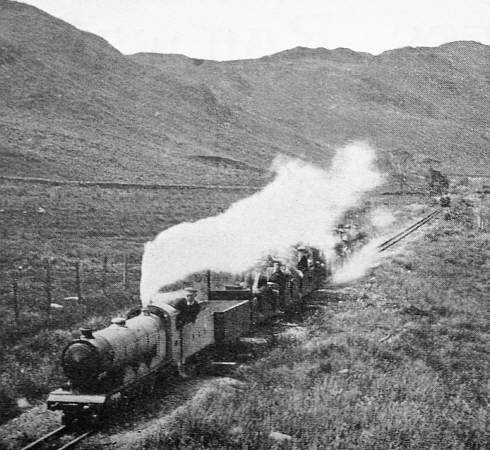
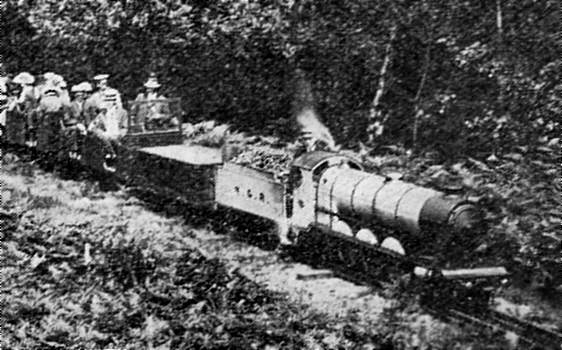
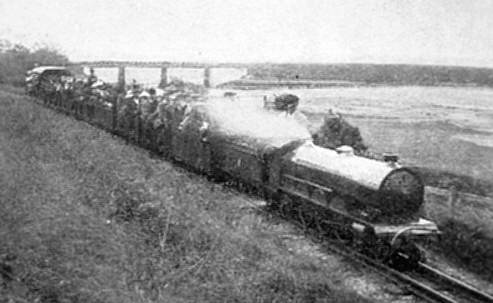
The second issue of the glossy Furness Railway Magazine, dated April 1921, cannily included a feature on the Ravenglass and Eskdale Railway. Some of the text went over the same ground as earlier articles also quoted on this website, but here's most of it, including selected photos (all the illustrations for the article were re-used for the railway's officlal guide by Henry Greenly, published a couple of years later and reprinted quite recently), preceded by an advert from issue 1, published at the end of 1920:
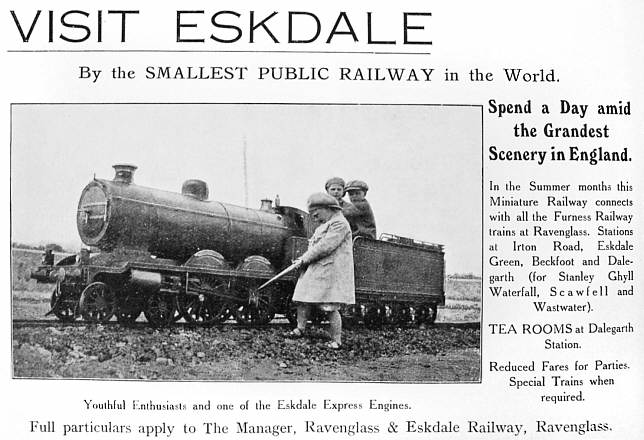
Eskdale Railway advert, 1920
... "It is here that you may find out the real meaning of the term "transport of joy" and experience "a joy ride". A ride on the Ravenglass and Eskdale Miniature Railway not only gives supreme delight and fun to the children for quite obvious reasons, but also considerable interest and enjoyment to the grown-ups who not only marvel with amazement, but are quite at a loss to find suitable adjectives to express exactly what it feels like. The effect of the ride is at least refreshing and rejuvenating- "How jolly! Really, I must be getting quite young again." The journey from Ravenglass to Dalegarth in such ideal surroundings will be a topic of conversation in days to come, and you will advise your friends to go and see for themselves."
Eskdale Railway advert, 1920
[Then follows the usual summary of the railway's history, giving the gauge of the old line as 2ft. 9in.]
"Passenger traffic ceased in 1908, and the line became derelict until the summer of 1915, when it was taken over by a new Company, and entirely reconstructed on a 15 inches gauge during the two years following, in spite of many difficulties in the way of private enterprise during the war.
This new development, which has produced such astonishing results, has been largely due to the efforts of Mr. R. Proctor Mitchell, who has been for many years past actively engaged in popularising Norway as a pleasure resort, through the agencies of the Viking Touring Company. Mr. Mitchell is the General Manager of the Eskdale Railway, and has worked in conjunction with Mr. W.J. Bassett Lowke, from whose works at Northampton engines and rolling stock for the Miniature Railway have been produced.
The train we travel by is made up of vehicles mainly of an open type, easy to mount, seating two a side. If the weather be unfavourable covered carriages are available, and, if the need arose, the Company could put on a special "sleeping car"; but given fine weather, the open cars are preferred, as they afford the traveller an uninterrupted view of the ever-changing scenery en route.
The covered cars are 12-seater bogie coaches, with a tare of 26cwt. These vehicles are complete with latched doors and windows, and are quite comfortable. The goods stock consists of open wagons and flat timber trucks of various designs. Coal, food and other stores are consigned to the residents of Irton Road, Eskdale Green, Boot and Beckfoot. Besides this, His Majesty's mails are carried either by the ordinary train or by a special petrol scooter locomotive."
Eskdale Railway advert, 1920
[Then follows a brief introduction to the challenges faced by locomotives, including gradients up to 1 in 35]
.. "but our little engine is quite equal to the task of climbing these, and of hauling loads about five times its own weight. In fact, the work done by the model engine is much greater in proportion than that performed by the most powerful engine of the normal gauge.
The engine to which we refer is the 4-6-2 or "Pacific" type, "Sir Aubrey Brocklebank," the largest model locomotive in the world, which is built to scale, one quarter full size.
Weight in working order, with tender, 3 tons 13 cwts.
Length over buffers, 18' 2"
Height to top of chimney, 3' 10"
Working pressure, 180lbs. per sq. inch
Cylinders, 4 3/8" dia. by 6 3/4" stroke
Heating surface, 13,083 sq. inches
Driving wheels, 20" dia.
Water capacity of tender, 90 gallons
Here is a chance for youths of a mechanical turn of mind, who collect, amongst other things, the names of engines. Such lists will not be complete without the "Sir Aubrey Brocklebank," who in real life (to quote from the "Model Engineer") is a gentleman of considerable experience in model locomotives. He has both family connections with this part of the Lake District, and is interested in the fortunes of the Miniature Railway.
Eskdale Railway advert, 1920
Other engines are the "Colossus" and "Sanspareil," the latter being built by Messrs. Bassett Lowke, Ltd., in 1912, from designs of Mr. Henry Greenly, for the Geneva Miniature Railway. This was the first engine on the Eskdale Line, and is still doing good work. There are many delightful excursions of interest to be made in the Eskdale neighbourhood, such as to Stanley Ghyll waterfall, which is about half-an-hour's walk from Dalegarth; or to the Head of Wastwater; or the more ambitious climber may even try the ascent of Scawfell (3,210ft.).
But go and see for yourself the fascinating charm of this Miniature Railway.
(For much in this article we are indebted to the courtesy of the editor of the "Model Engineer," to Mr. R. Proctor Mitchell, and officials of the R. & E. Railway.)"