 | |
The Friends of the Lake District collection at Kendal Record Office contains a fascinating file on the 1955 proposals to develop Beckfoot quarry in Eskdale (ref. WDSO 117/B/VIII/7). Here is a summary of the story:
Early in 1955, the Keswick Granite Company began negotiating with the local Planning Authority (Cumberland County Council, acting on behalf of the Lake District National Park) for a resumption of quarrying at Beckfoot in Eskdale on more economically practical terms than previously. The Council pointed out that the valley road was quite unsuitable for the proposed 20 five-ton truckloads of chippings per day, to which, on 14 March, KGC replied that they were willing to transport the stone on the miniature railway, but warned that this would both interfere with tourist traffic and increase costs- they also asked for deletion of a clause in their planning permission (dated 17 Nov 1949) prohibiting the installation of a crushing plant within the quarry.
On 7 April 1955, a planning inspector visited the site with company representatives, who explained that the proposals were part of a wider scheme to focus the company on economical production of good-quality granite, which in this instance meant abandoning the awkward "double-handling" involved in transporting stone from Beckfoot for crushing at Murthwaite- and also abandoning the practice adopted by the former owners of the quarry, Narrow Gauge Railways Ltd., by which Beckfoot quarry was worked only in winter, while another quarry on Muncaster Fell near Murthwaite was worked in summer (this multi-site quarrying and crushing operation had been set up in 1922-3). KGC General Manager Mr J.H. Davies, also explained that Murthwaite granite was of lower quality and under a greater "overburden" than Beckfoot, while the high-quality Broad Oak quarry at Waberthwaite had limited capacity for expansion. Mr Davies indicated that in the past the company had transported about 80 tons of stone from Beckfoot by road per day, and requested that this be allowed to continue, the intention being initially to undertake a similar blast to that of 20 Aug 1949. The proposed crushing/screening plant within Beckfoot quarry would be 36ft high, but sunk about 8 feet into the quarry floor and screened by trees (mostly hazel & silver birch, with conifers).
Following this visit, and bearing in mind the County Surveyor's view that the valley road could not be used for 20 5-ton loads of unprocessed stone per day, the inspector was minded to permit the installation of the crushing plant at Beckfoot. However, the Planning Authority did not actually have the power to revoke the earlier clause (which he referred to as condition 4 of permission granted on 16 Jun 1950) forbidding the development, so the matter would have to be referred to Westminster.
Learning of this, over the next few months objectors began writing to the Minister for Local Government, who would be making the decision, and an enquiry was announced, to be held from 23 Nov 1955 at the Scawfell Hotel, Seascale (unfortunately the day the Duke of Edinburgh was due to visit Sellafield). The institutional objectors included the Friends of the Lake District and the Ramblers' Association, both represented by the Rev. H.H. Symonds, very experienced in such camapigns, who did much of the co-ordination of objections. The Co-operative Holidays Association, owners of the nearby Stanley Ghyll Guest House, put in their objection on 21 October. The Youth Hostels Association, however, felt that their Eskdale hostel was too far away for them to be legitimate objectors. The Fell and Rock Climbing Club not only put in an objection, but one of their committee members who happened to be a neighbour of Mr McGlasson of Keswick Granite Co. managed to get a few interesting hints about the company's strategy for the enquiry:
- Emphasise that the new crushing plant, tucked away in the quarry and screened, would be less visible than Murthwaite.
- Claim that the Murthwaite plant was uneconomic, and the Beckfoot quarry would not be viable without the new crushing plant- whereas if permission was given, the operation could employ up to a dozen men.
- Point out that the subsidiary firm owning the Quarry also owned the "Ratty" miniature railway, and if it collapsed the railway would close.
- Reassure objectors that because of the isolation of the site there was no question of expanding to a Shap-scale operation.
- Emphasise also that measures would be taken to control dust and noise.
These handy insights were passed on with requests to "treat the enclosed with every discretion".
In addition, Friends of the Lake District obtained technical information from "A local source" (actually former quarry and railway employee Bert Thompson):
- When the Eskdale quarrying operation was shut down in Jul 1953, there had been 4 men working Beckfoot Quarry, 4 at Murthwaite crushing plant (including the foreman), 1 lorry driver and 1 man working a train of hoppers- when extra lorries were needed, they were brought in from other KGC operations.
- 2 former workers for the company in Eskdale were said to have suffered from silicosis, and the dust (which in some circumstances could be as much as 25% of the stone quarried) is a pollutant (keeping dust down with water results both in machinery problems and the production of a sludge).
- One economic use for the dust is the manufacture of briquettes- so KGC would be likely to apply at some later date for permission to instal another plant at Beckfoot for this purpose; also because of increasing demand for pre-tarred chippings for major roads, KGC would probably want to instal a plant to do this too.
- The quarry area would have to be evacuated during shot-firing operations to break up large blocks- if the crusher was inside the quarry, it would have to shut down at these times, unless it had substantial protective screening.
- Lifting the standard gauge track from Murthwaite to the main line at Ravenglass had been KGC's "first act upon closing down in 1953"- Miss Burnett pointed out that steel rails were then fetching high prices.
- And finally: "The suggestion by K.G. Co., that they would discontinue operations by 'Ratty' if their application is refused deserves study. It may well be that if there were a threat of closure the body which lately took over and operated the Talyllyn model railway, or some kindred body would be interested in maintaining the service?"
Further F.o.t.L.D. observations from local information and study of relevant documents:
- The company had permission to extend the quarry horizontally about 100 yards into the face of the fell (which would make the face up to 125ft higher), plus 50 yards left and 50 yards right from the existing excavation.
- Though screened from the road, the quarry would be visible from three paths.
- The Murthwaite site for the crushing plant had been chosen by Narrow Gauge Railways specifically because it was naturally concealed and isolated (being nearly half a mile from the nearest public road, and not visible from the ridge of Muncaster Fell).
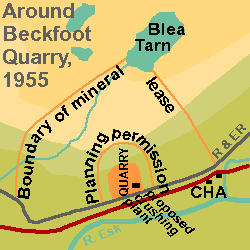 At the enquiry, before Government inspector Mr S.T. Roberts, the "closing Ratty" card was indeed played more-or-less straight away, according to a report in the Whitehaven News, 24 Nov 1955. Objectors pointed out that "until a fortnight ago they had never heard that the railway was in peril" (Whitehaven News, 1 Dec 1955). On a more technical level, the company stated that its aim was to produce 30,000 tons of crushed stone annually. They first estimated that half a million tons of stone was available within the existing planning permission, then apologetically corrected that to 1 million tons; however the company's map indicated that the area covered by their mineral lease from Leconfield estates was much larger (see map). The crushing plant would be installed at the east side of the quarry floor, with the crusher itself 6-8ft below ground; it would be clad with a double sheet of corrugated asbestos, with felt in between to deaden noise.
Despite carrying some 40,000 passengers in the summer of 1954, the "South Cumberland Granite Co.", the subsidiary which ran the Eskdale operations, made a loss of £13,000 over the period 1949-54. Friends of the Lake District struggled to interpret the financial information in the light of Bert Thompson's pre-1953 employment figures, the current staff of 7 (total wage bill no more than £3,500), and return fares of 3/9 (1/9 for children). They wondered "How much of the profits of the railway have been claimed as 'over-heads' by the parent Co." It was also stated that the railway had 50,000 passengers in the 1955 season.
Friends of the Lake District also noted that the small Broad Oak quarry could potentially be extended via a tunnel under the road, as at Shap, and that the Company's mineral lease there (from the Muncaster estate) was due for renewal in February 1956. Also, though the company claimed that the quarry would employ 8 extra men, technical evidence suggested that only 4 would be needed- also Eskdale had full employment already.
H.H. Symonds (speaking officially for the Ramblers' Association) made the interesting point at the enquiry that the "separate" company South Cumberland Granite was likely to be found not to have the finance to carry out the required site clear-up after the quarry was eventually worked out.
The enquiry hearing did not take long- but the decision-making process took months. The official letter from the Minister for Local Goverment to Keswick Granite Company on consideration of the report by his inspector was not sent until 4 May 1956. Subject to certain conditions (e.g. no Sunday or night-time working) he approved the proposal. Then it took a while for the news to leak out- the Whitehaven News did not report it until 17 May. Then it took even longer for Friends of the Lake District to get hold of a copy of the letter, which they duplicated and sent out to other objectors on 4 July. Actually, it's not clear quite how they got hold of the letter: the Ministry wrote to them several days later apologising that they could only provide a summary, not a full copy, because it contained confidential information.
The idea was for the objectors to lodge an appeal- but there are no documents in the file relating to any such process, and as noted in the official history of the "Ratty", events in the following year were to follow a path which could not have been predicted in 1955. The crushing plant was never built...
