PastPresented.info

LA'AL RATTY IN 1916


To Eskdale index 

The magazine "Railway and Travel Monthly" featured in its June 1916 article a very detailed (but sadly anonymous, though I suspect either Mr Bassett-Lowke or Mr Mitchell) article about Eskdale, focusing on what it called "The Reconstructed Ravenglass-Eskdale Line". Here I have omitted the introductory description of the valley- and I advise caution when reading the historical introduction to the railway itself, which opens this long extract:
A Super-Scenic English Railway

"Right down the western coast of Cumberland there run traces of a seam of the finest hematite iron ore, away from Cleator, Frizington and Kelton Fell in the north, down to Hodbarrow and Lindal in the south; from the mines at its northern and southern extremities, the rapacious blast furnaces of the Workington and Barrow-in-Furness districts are kept supplied with the ore, for conversion into pig-iron, and later into steel. Now, this seam crosses the upper part of Eskdale near the little village of Boot, and the great demand for ore that arose in 1872 after the Franco-Prussian War led to a company being formed, called the Whitehaven Iron Mines, Ltd., in order to extract the ore in various places, including Blea Tarn, above Beckfoot, and Nabb Ghyll, above Boot. Ore-mining was profitable in those days, as the handsome amount of 32s. per ton was obtained for the precious mineral, delivered into trucks on the Furness Railway at Drigg station. But the fact that 10s. of this sum was vanishing in cartage led to the projection of a tramway or railway from the mines down to the coast, and the Act furnishing the necessary powers was obtained in 1873. It was at first proposed to run the narrow gauge line down the whole length of Eskdale to Eskmeals, but the superior claims of the old Roman port of Ravenglass led to the railway being diverted round the head of Muncaster Fell from Eskdale into Miterdale, and so down to the latter town. The powers included the right to construct a branch at Ravenglass along the foreshore, with the necessary jetties and wharves; but eventually the railway was carried into the Furness railway's station at Ravenglass, where suitable arrangements were made for tipping the ore into the standard gauge trucks. In April, 1875, the line was completed to Boot, and on June 1st of the same year goods traffic was commenced; but owing to certain requirements of the Board of Trade having to be complied with, passenger traffic was not begun until November 9th, 1876.

The existence of the old Eskdale Railway was never any more than a precarious one at best. Only two years after its opening, the contractor for the line sued the proprietors for £17,000, and won his case, with the result that the railway was forthwith placed in Chancery. Furthermore, the purchase price of ore had, by 1882, dropped from 32s. to 8s. per ton, with the result that, ere long, the mines could no longer be worked profitably, and were closed down. After dragging on a weary and profitless existence for some time subsequently during the whole of which it was gradually getting into worse and worse repair, and becoming more a byword in the district, the railway gave up the unequal contest towards the end of the last decade, and was closed also. Now this was a serious matter for Eskdale, as during the operation of the railway a quantity of residential property of a very good class had sprung up round the line, particularly at the beautifully situated village of Eskdale Green, and by the closing of the railway this was cut off from civilisation, save by a comparatively lengthy and expensive road transport. Consequently it was with enthusiasm that the inhabitants of Eskdale received the news last year that a small private company, known as "Narrow Gauge Railways, Ltd." (under the directorship of R. Proctor Mitchell and W.J. Bassett-Lowke), had obtained a lease of the line, and were about to commence the work upon it that was necessary to set it in running order once again. Their surprise as the reconstruction proceeded must have been considerable. They had looked upon the original line with its gauge of 2ft. 9ins. as more or less of a "toy" railway; but now they saw the gauge being still further contracted to 15ins.- a "toy" railway, indeed! When the first locomotive appeared on the scene their astonishment must have been still greater as they compared their mental picture of the clumsy old six-coupled "tanks" that used to work the line with this trim little "Atlantic" express engine, in its bright blue livery. But astonishment soon changed to respect when it was found that the diminutive locomotive had greater capabilities in the way of speed than its predecessors, and that the infinitesimal cars, with their two seats a-side, were, after all, just as comfortable to ride in as the old ones- and even more so.

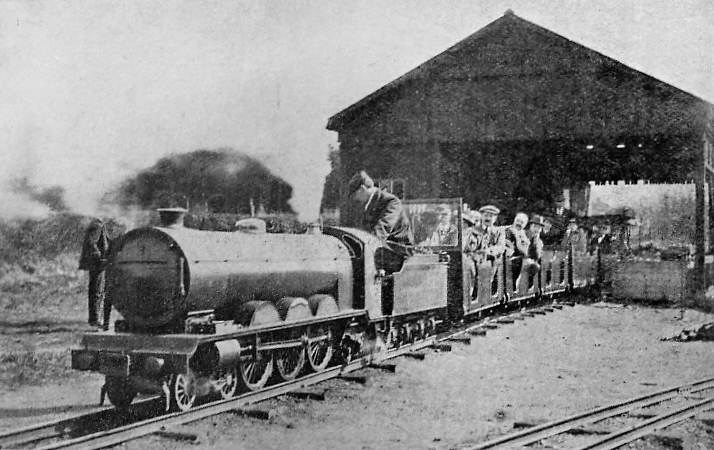
Train drawn by the 4-6-0 locomotive COLOSSUS, leaving Ravenglass Station

Frankly, the 15ins. gauge on a line of this character is an experiment. Most of us are familiar with the numerous lines of this character that have been laid down in exhibitions and marine parks and elsewhere, but this is the first time that a public railway has been operated to so narrow a gauge in the open country, and this is why the Eskdale Railway can lay claim to the proud title of the "Smallest Gauge Public Railway in the World." The late Sir Arthur Percival Heywood, Baronet, whose death was only recorded recently, spent a lifetime in the advocacy of what he termed "minimum gauge railways," and fully demonstrated their possibilities, first on his own 15-in. gauge line at Duffield Bank, near Derby, and later on the line that he laid down for the Duke of Westminster from Balderton station on the Great Western Railway, to Eaton Hall, in Cheshire. The total length of the latter railway, with its branch, is 3¾ miles, and, although it has no passenger service, and the engines are only in steam on certain days, it conveys a total traffic of some 5,000 or 6,000 tons annually. In the Eskdale Railway, however, we have a much more ambitious experiment. The length of the line is over 7 miles, and an ample passenger train service is run daily, in addition to parcel traffic and the carriage of coal and other stores. And the major part of this traffic is entrusted, not to locomotives of the contractors' "tank" type, as used at Eaton and Duffield Bank, but to miniature scale model express locomotives of the pattern familiarised by their makers- the well-known firm of Bassett-Lowke, Ltd., of London and Northampton. Needless to say, the attraction of the railway is thereby greatly enhanced, and, in comparison with the railways of similar gauge that have been run round the confines of exhibitions , with a background of excavated lakes and manufactured mountains, it is not too much to speak of the Eskdale line, surrounded by the finest scenery that nature can offer, as a "Super-Scenic Railway."
The 12.15pm ex Ravenglass approaching Eskdale Green Station, hauled by SANSPAREIL and COLOSSUS. The train on this trip carried 73 passengers.

The best way in which to make the reader realise the interest of the Eskdale Railway and the beauty of its surroundings is to attempt to give a word-picture of a journey over its length. In order to reach Ravenglass the tourist has to patronise a considerable length of the Furness Railway main line from Carnforth- that sinuous route which has perforce to cover a distance of 45 miles in the first stages of its journey past Barrow-in-Furness to Millom, instead of a "bee-line" of 21 miles, owing to the deep indentations of the sea on the Lancashire coast. At Foxfield we pass from Lancashire into Cumberland, and after rounding thesolid projecting mass of Black Combe, 1,978ft. high, past Millom and Bootle, we cross the Esk estuary at Eskmeals, and reach Ravenglass. Four miles further on is the rising sea-side resort of Seacale, and 16¾ miles distant is Whitehaven. Through coaches run between London (Euston), Liverpool, Manchester, and other chief London and North Western Railway stations and Whitehaven, on the principal trains, calling at Ravenglass, and through trains from Leeds, Bradford, and the Midland railway system generally connect with the Furness Railway at Carnforth, so that Eskdale is thus quite easy of access. Arriving at Ravenglass we find the "Eskdale Express" waiting for us in the adjacent miniature railway station, but the Eskdale service is so generous, as the annexed time-table shows, that there is time to look round Ravenglass before proceeding up the valley. The village stands on a projecting tongue of land with the Esk estuary on the south, and the estuaries of the Irt (draining Wastwater) and Mite on the north. It consists of a long straggling street of "briny" aspect, and with associations going back to Roman times, when it used to be the seaport of the district. Across the northern estuary, acccessible by boat, there is a celebrated "gullery" among the sand dunes, where many thousands of terns and gulls have bred unmolested for years past. The principal attraction of the district, however, is Muncaster Castle and its surrounding park. Lord Muncaster, who, by the way, is now the chairman of the Furness Railway Company, with great consideration allows visitors the unrestricted entrée of his grounds, except on Sundays, including the famous Castle "terrace," with its magnificent panorama of the whole of lower Eskdale.

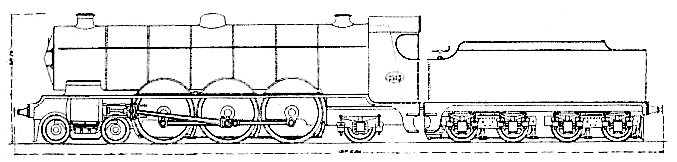
COLOSSUS

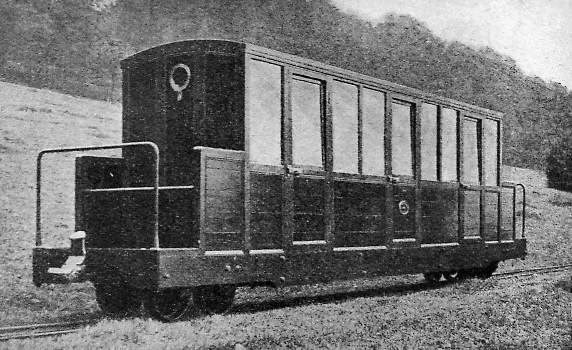
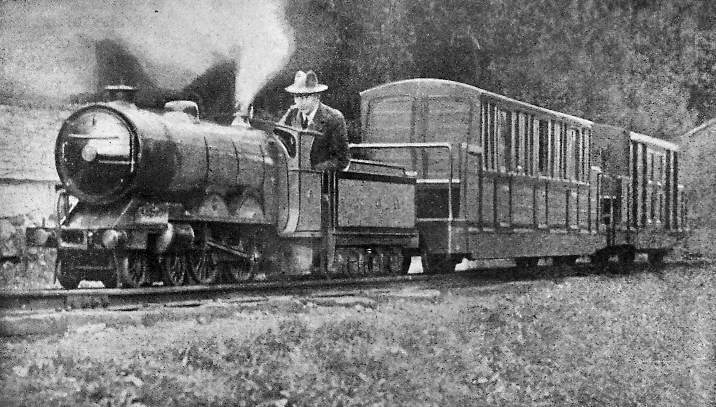
But revenons à nos moutons, or rather, to the "Eskdale Express," which we left standing at Ravenglass station. The Eskdale Railway now owns two passenger and one goods locomotive, the former being scale model express engines, and the latter a four-coupled four-wheeled tank locomotive of a contractor's type. Both the express engines are fine examples of the skilful workmanship of Messrs. Basset-Lowke, Ltd. One has the 4-4-2, or "Atlantic" wheel arrangement, and is called Sans-pareil, and the other is a 4-6-2, or "Pacific" locomotive, named Colossus, and is the largest scale model engine that has ever yet been built. Each engine is down-to-date with all modern accessories, including super-heater and mechanical lubrication! The remaining engine was built by the late Sir Arthur Heywood at Duffield Bank, and has been purchased from the Duke of Westminster's eaton Railway for heavy goods service. For those who revel in technicalities, the dimensions of the three types are appended. Coaches are mostly of the four-wheeled open pattern, seating eight passengers, two a-side, as these vehicles are the best for giving an uninterrupted view of the scenery en route. For wet days and winter work, however, there are four covered compartment bogie coaches- quite the "real thing"- each seating twelve pasengers inside and four outside. Equipment is completed by a covered bogie brake-van, and an open bogie parcel-truck, together with other wagons of various sorts and capacities, as coal and merchandise are conveyed by the miniature line just as by the original Eskdale Railway. At ravenglass we find the office of Mr. John Wills, the General Manager of the line. Adjacent to the station is an engine and car shed, this being the principal depot on the railway.
One of the enclosed carriages

Time being now up, the "right away" is given, and we commence our journey to Beckfoot. The train is a "down" train, but the journey is very decidedly "up" except in its earliest stage, where the line descends to the side of the estuary of the Mite, and skirts it for some distance. Along this length there is a magnificent view of the whole of the Cumbrian mountain chain, dominated by Great Gable and Scawfell- a view, indeed, that is enjoyed throughout the first half of the journey. A run of just over a mile brings us to Muncaster, the first station, under the steep slope of Muncaster Fell. The Fell is an isolated and rocky ridge that runs inland some 4 miles from Ravenglass, dividing Miterdale from Eskdale, and attains a maximum height of 760ft.; hence the railway for the first 4 miles or so of its course is not in Eskdale at all, but in Miterdale. Starting again, we commence to climb, skirting the north side of Muncaster Fell, and encountering on the way some steep gradients, which test the tractive capacity of our miniature steed to the full.

4-4-2 locomotive SANSPAREIL with covered passenger coach and parcel van

After leaving Muncaster, indeed, here is a short length up over the mill-race as steep as 1 in 33. The driver, of whom we get an excellent view from our point of vantage in the train, comfortably seated on the tender, has his work cut out along here, what with attending to the fire and injectors and keeping a look-out round the many curves and twists on the line. There is every need of the latter precaution, as, despite the best provision in the way of fencing, lambs, sheep, fowls, and other zoological specimens seem to take a specially perverse delight in exercising "right of way" upon the railroad. After climbing exactly 100ft. from Muncaster we round Prospect Point- a double reverse curve high up the hillside, commanding a striking mountain panorama- and then, 4 1/8 miles from Ravenglass, we reach Irton Road station. Irton Road adjoins the beginning of the straggling village of Eskdale Green- a splendid holiday centre, well equipped with a good inn, several boarding and refreshment houses, and a number of well-built houses of all kinds to let- both furnished and unfurnished. The varied views of mountain and dale comanded in every direction are as good as anything that the English lake District has to offer, and the range of possible excursions is no less comprehensivee. Wasdale and the foot of Wastwater are within 5 miles by road, or 3½ miles by a well-defined moorland path over the shoulder of Irton Fell. After leaving Irton Road, the railway curves southwards round the extremity of Muncaster Fell, and a rapid downhill run brings us into Eskdale proper, the next station being Eskdale Green, at the further end of the village of that name.

The same excursions are possible from here as from Irton Road, with the addition of the walk down Eskdale to Eskmeals, or a breezy stroll along the whole length of Muncaster Fell, with its incomparable open views down to Ravenglass. Shortly after these lines appear in print it is expected that the next section of the Eskdale Railway will be open as far as Beckfoot, 6½ miles from Ravenglass. The line still ascends the valley, which now contracts and becomes much wilder and more mountainous as we approach Boot. Rounding one or two horse-shoe bends, where railway, road and river are closely adjacent, we come in sight of the imposing Stanley Ghyll Guest House of the Co-operative Holiday Association, and shortly afterwards draw up at Beckfoot Station. This is the nearest point of access to Stanley Ghyl- the remarkable rock cleft previously mentioned- and Dalegarth Force, where the Birket Beck has a sheer fall of 60ft.

The stations are as follows:-
Dist. MilesHeight above Sea Level FeetStations
036Ravenglass
1 1/817Muncaster
4 1/8127Irton Road
4 7/8102Eskdale Green
6 1/2148Beckfoot
7 1/8211Boot

On weekdays there are seven trains in each direction, the journey from Ravenglass to Beckfoot occupying 40 mins. From Beckfoot to Ravenglass the times on journey vary from 40 mins to 50 mins. On Sundays there are three trains in each direction between Ravenglass and Beckfoot, with an extra morning one to and from Ravenglass and Irton Road, and an evening one to and from ravenglass and Eskdale Green. The trains leave Ravenglass for Beckfoot at 6.40, 9.40, 11.20 a.m., 12.15, 3.10, 4.10, and 6.40 p.m. on weekdaly; and at 9.20 (to Irton Road), 10.40 a.m., 2.0, and 4.30 p.m., also at 6.30 p.m. for Eskdale Green on Sundays. Beckfoot to Ravenglass:- Weekdays, 7.30, 10.40 a.m., 12.20, 2.5, 5.0, and 8 p.m. Sundays, 11.40 a.m., 3.5, and 5.25 p.m.; also at 9.50 a.m. from Irton Road and 7.15 p.m. from Eskdale Green.

DIMENSIONS OF LOCOMOTIVES
EngineSanspareilColossusKatie
Type4-4-2 (Tender)4-6-2 (Tender)0-4-0 (Tank)
Cylinders (diameter)4 1/8 ins.4 3/8 ins.4 5/8 ins.
    "   (stroke)6 ins.6 3/4 ins.7 ins.
Driving Wheels (diameter)20 ins.20 ins16 ins.
Total Heating Surface76 1/2 sq. ft.91 sq. ft.53 sq. ft.
Working Pressure (per square inch)130 lb.130 lb.160 lb.
Length over all16 ft. 4 ins.18 ft. 2 ins.8 ft.
Weight in working order2 1/4 tons3 tons3 1/4 tons
Maximum speed capacity on level30 m.p.h.35 m.p.h.20 m.p.h.
Maximum load capacity on level13 tons17 tons22 1/2 tons

The exact date of opening the final length of the Eskdale Railway to Boot cannot yet be stated, but from Beckfoot station, Boot village is only ½-mile distant by road. We are now right in the heart of the mountains, and the good walker has the choice of a variety of perspiring excursions, such as the ascent of Scawfell, 3,210ft., passing on the way the fine Upper Eskdale Falls; the passage of Hardknott and Wrynose Passes over into Langdale and Ambleside, by a good track, 16 miles in all; or the ascent of the Whillan Valley to Burnmoor Tarn, under the shadow of Scawfell, and the descent to the head of Wastwater- an easier walk of about 6 miles- to name but a few examples. The Roman Camp at the foot of Hardknott and the Druidical remains above Boot are other centres of no small interest. It would be of little use at this stage to describe the return journey to Ravenglass, as the reader who has accompanied us will have so fallen a victim by now to the charms of Eskdale, we feel sure, that we shall have to leave him there until the next number of the RAILWAY AND TRAVEL MONTHLY is published !